
At the doctor's: the doctor, the pharmacy, 111 and 999 · Past Simple — irregular verbs, questions and negatives
Level: A2. Grammar: the Past Simple of irregular verbs; questions and negatives with did. Situation: make an appointment with a GP, describe symptoms, talk to a pharmacist, understand where to call. Builds on u12 (was/were and regular verbs in -ed) and u04 (have got).
1. The situation
On Monday Marina woke up with a sore throat. By the evening she had a temperature, and at night she hardly slept. On Tuesday she calls the surgery — that is what the family doctor's practice (GP, general practitioner) is called in Britain. The receptionist asks questions: What seems to be the problem? When did it start? Did you take anything for it?
Marina understands the questions, but answering is hard: it all happened yesterday and the day before. To talk about it you need the Past Simple, and the verbs you need most — feel, have, sleep, take, go, begin — are irregular.
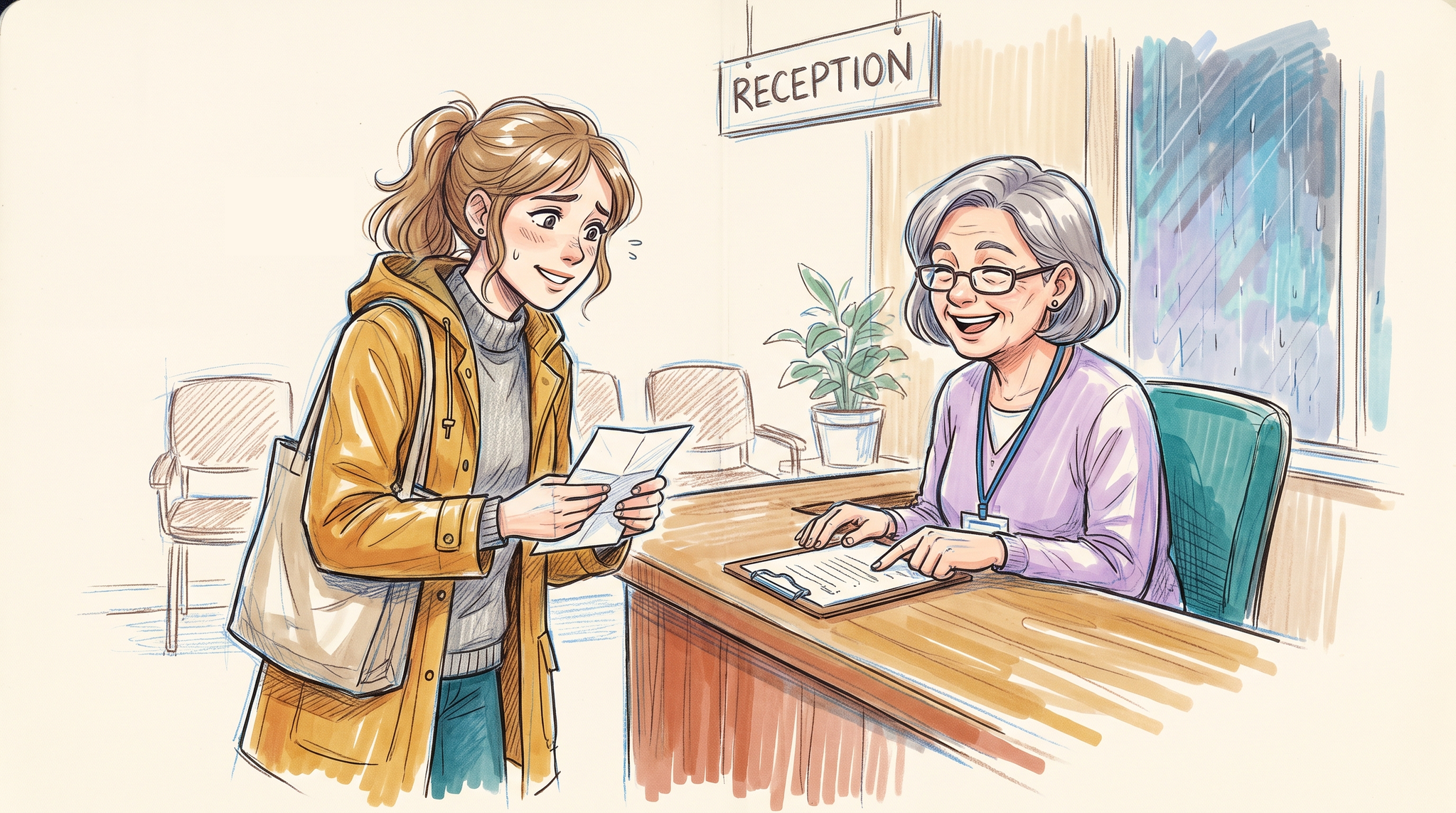
Description
Цветной скетч карандашами и маркерами, персонажи в аниме-манере. Слева Марина — женщина под сорок, светло-русые волосы в хвосте, горчично-жёлтый дождевик поверх серого свитера, холщовая сумка на плече. Она держит сложенное письмо и чуть наклонилась к стойке, улыбается вежливо и немного нервно, как будто задаёт вопрос. За стойкой справа — весёлая седая администратор в очках и с бейджем на шнурке, она улыбается и показывает на форму на планшете. Сзади пустые стулья, растение в горшке, окно с дождём. Над стойкой табличка RECEPTION. Идея: в регистратуре первый разговор — короткий и вежливый, и к нему можно подготовиться.
2. How it works in Britain
Briefly, only what you need for the conversation. The information was checked against nhs.uk on 3 October 2026.
- GP surgery. You don't go to "the clinic for your registered address", you go to your own GP practice. To use it, you need to register (register with a GP). You need your name, date of birth and address. Proof of identity, proof of address and immigration status are not required; an NHS number is helpful but not essential. You can register online, with a paper form or right at the surgery; processing usually takes up to 5 days.
- An appointment — by phone, online or through the NHS App. The receptionist often asks what the problem is. This is not curiosity: it is how they decide how urgently you need to be seen and by whom — a doctor, a nurse or a pharmacist. If you don't want to say, you can say politely: I'd rather speak to the doctor about it, if that's OK.
- Pharmacy (in conversation also chemist's). The pharmacist gives advice free of charge and without an appointment. In England, under the Pharmacy First scheme, they can give you a prescription medicine themselves for some minor problems, for example a sore throat that has come on suddenly.
- 111 — if you need help urgently but your life is not in danger, and the surgery is closed (evening, weekend) or you don't know where to go. The call is free. There is also 111 online. You can ask for an interpreter: Can I have an interpreter, please? Russian.
- 999 — only when there is a threat to life: chest pain, a person can't breathe, is unconscious, heavy bleeding, signs of a stroke. The operator will ask: Which service? — answer Ambulance.
Description
Дерево решений сверху вниз из трёх вопросов. Первый вопрос: есть ли угроза жизни — боль в груди, человек не может дышать, без сознания, сильное кровотечение. Если да — звонить 999 и сказать Ambulance, please. Если нет — второй вопрос: небольшая ли это проблема, например боль в горле, простуда, боль в ухе. Если да — в аптеку, к фармацевту. Если нет — третий вопрос: открыта ли ваша GP surgery. Если да — звонить в surgery и записаться на приём. Если нет — звонить 111 или использовать 111 online. Возле каждого ответа — фраза, которую можно сказать.
3. Phrases: take them with you
At reception or on the phone
- Hello, I'd like to make an appointment, please. — Hello, I'd like to book an appointment.
- I'm not registered yet. How can I register? — I'm not registered yet. How do I register?
- Is there anything today? / Do you have anything earlier? — Is there anything for today? / Anything earlier?
- It's quite urgent. — It's fairly urgent.
- Sorry, could you say that again more slowly? — Sorry, please repeat that more slowly.
- Could you spell that, please? — Spell it letter by letter, please.
Describing symptoms
- I've got a sore throat / a headache / a cough / a temperature. — My throat hurts / my head hurts, I have a cough, a temperature.
- My back hurts. / It hurts here. — My back hurts. / It hurts right here.
- It started three days ago. — It started three days ago.
- I didn't sleep last night. — I didn't sleep last night.
- I took some paracetamol, but it didn't help. — I took paracetamol, but it didn't help.
Words
| English | Meaning | Note |
|---|---|---|
| headache, stomach ache, earache, toothache, backache | pain in the head, stomach, ear, tooth, back | ache is pronounced [эйк]; stomach — [СТАмэк] |
| sore throat | a sore throat | throat: the th sound, tongue between the teeth |
| a temperature | a (raised) temperature | with the article: I've got a temperature |
| a cough, a cold | a cough, a cold | cough — [коф] |
| I feel sick | I feel nauseous | not "I'm ill"! "I'm ill" is I'm ill / I'm not well |
| a prescription | a doctor's prescription | recipe — a recipe for a dish, receipt — a till receipt |
| dizzy | your head is spinning | I feel dizzy |
| a rash | a rash |
4. Grammar: Past Simple — irregular verbs
The pain
In u12 you learned to talk about the past with regular verbs: I called, it started, I booked. But the most common verbs are irregular, and each has its own past form. Without them you can't say either "I felt unwell" or "I went to the pharmacy".
Form
In an affirmative sentence an irregular verb has a second form — you need to memorise it:
| Verb | Past Simple | Example |
|---|---|---|
| be | was / were | I was ill on Monday. |
| have | had | I had a temperature. |
| feel | felt | I felt terrible. |
| sleep | slept | Max slept badly. |
| go | went | I went to the pharmacy. |
| take | took | I took some paracetamol. |
| get | got | I got a prescription. |
| begin | began | The pain began on Sunday. |
| buy | bought | I bought some throat sweets. |
| see | saw | I saw the doctor yesterday. |
| give | gave | The pharmacist gave me some tablets. |
| say / tell | said / told | The doctor told me to rest. |
| eat / drink | ate / drank | I didn't eat much, but I drank a lot of water. |
| hurt | hurt | It hurt a lot. |
| can | could | I couldn't sleep. |
Questions and negatives are built the same way for all verbs, regular and irregular: the auxiliary verb did and the base form.
| Pattern | Example | |
|---|---|---|
| question | Did + subject + base form | Did you take anything? |
| question with a question word | When / What / Where + did + subject + base form | When did it start? |
| negative | subject + didn't + base form | I didn't sleep. |
| short answer | Yes, I did. / No, I didn't. | Did it help? — No, it didn't. |
Where it breaks (the cost)
- Double past. Did you took…?, I didn't went. Did already carries the past tense, so the verb after it is in the base form: Did you take…?, I didn't go.
- Was and did together. I was go to the doctor — a mix of two constructions. You need either I went to the doctor's or I was at the doctor's.
- To be doesn't take did. Did you be ill? — wrong. Correct: Were you ill?, I wasn't well.
- "I went to the doctor". In British English it's I went to the doctor's (to the doctor's — like to the chemist's) or I saw the doctor.
- Ago comes after the period: three days ago, not ago three days. With ago — only the Past Simple.
5. Marina's story
Read it and pay attention to the highlighted verbs.
Last Monday Marina woke up with a sore throat. She felt tired, but she went to work. In the evening she had a temperature, and she didn't sleep well. On Tuesday she called the surgery at eight o'clock. The line was busy, so she tried again. The receptionist was very kind. "When did it start?" she asked. "Yesterday morning," Marina said. "Did you take anything?" "Yes, I took some paracetamol, but it didn't help." The receptionist said, "A pharmacist can help with a sore throat. Go to the pharmacy first." Marina went to the pharmacy on the high street. The pharmacist asked some questions and gave her some medicine. On Thursday Marina felt much better.
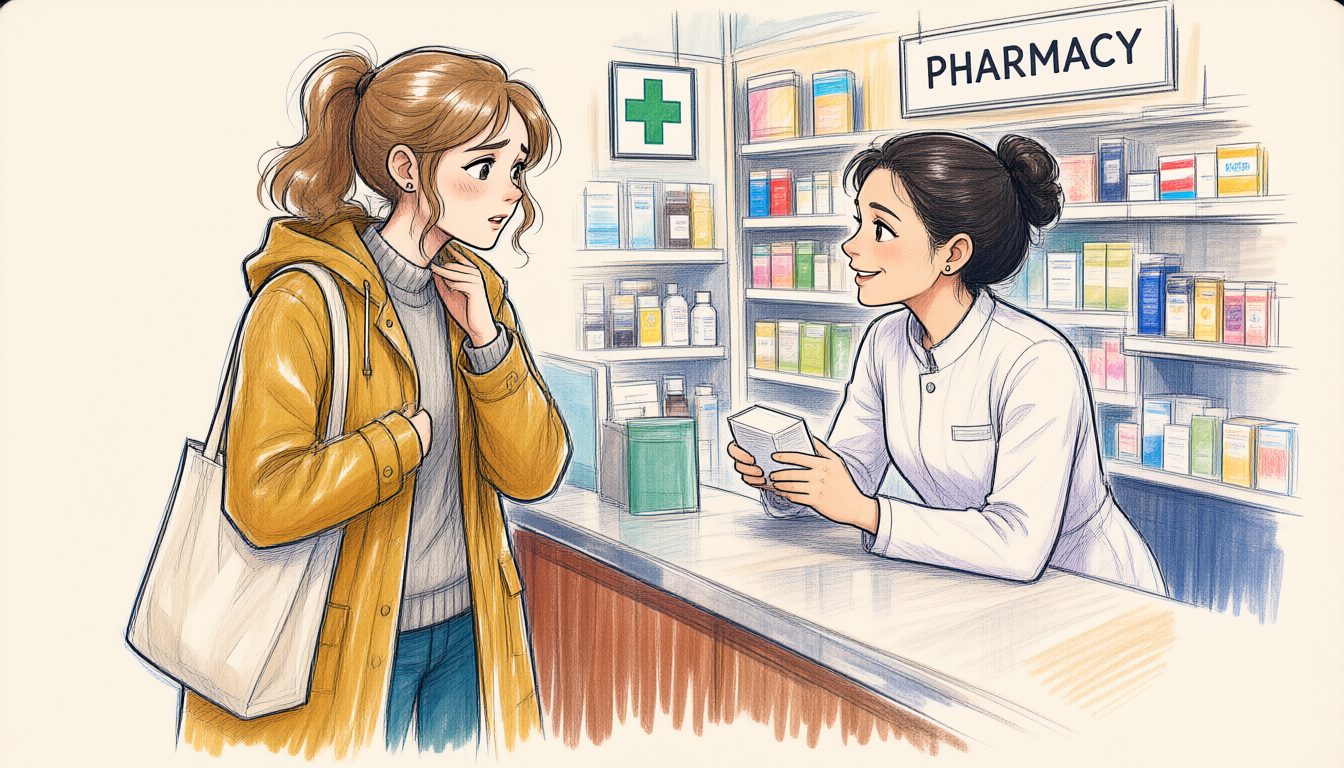
Description
Цветной скетч карандашами и маркерами, персонажи в аниме-манере. Слева Марина в горчично-жёлтом дождевике и сером свитере, с холщовой сумкой на плече. Она стоит у прилавка, держит руку у горла и объясняет, что болит горло; вид усталый, но с надеждой. За прилавком справа — доброжелательная женщина-фармацевт лет сорока в белой форме, тёмные волосы собраны в пучок. Она наклонилась вперёд, слушает и держит маленькую белую коробочку с лекарством. Сзади полки с разноцветными упаковками, на стене зелёный крест, над прилавком табличка PHARMACY. Идея: с небольшой проблемой сначала идут к фармацевту, и разговор там строится на тех же фразах о симптомах.
6. Dialogue: calling the surgery
Receptionist: Good morning, Ashbury Surgery. How can I help? Marina: Hello. I'd like to make an appointment, please. Receptionist: Can I take your name and date of birth? Marina: Marina Petrova, the fifth of March, nineteen eighty-eight. Receptionist: Thank you. What seems to be the problem? Marina: I've got a sore throat and a temperature. It started on Monday. Receptionist: Did you take anything for it? Marina: Yes, I took some paracetamol, but it didn't help. Receptionist: OK. Have you spoken to a pharmacist? Marina: No, I haven't. (For now just recognise this form — the Present Perfect comes in u18.) Receptionist: A pharmacist can often help with a sore throat. If you don't feel better in two days, call us again. Marina: OK, thank you. Sorry, could you say that again more slowly? Receptionist: Of course. Go to the pharmacy first. If it's not better on Thursday, call us back. Marina: Thank you very much. Bye.
Politeness. Compare how this sounds to a Brit:
| Abrupt (don't do this) | Normal |
|---|---|
| I want doctor today. | I'd like an appointment today, please. It's quite urgent. |
| Repeat. / What? | Sorry, could you say that again? |
| No. I don't want pharmacy. | I'd prefer to see a doctor, if possible. |
| Give me medicine for throat. | Could you recommend something for a sore throat? |
Softening here is not "humbling yourself" but the ordinary form. Without it a Brit hears an order, even if you meant nothing of the kind.
7. Sound
- Dates are said like this: the fifth of March (or March the fifth), the year in pairs: nineteen eighty-eight, two thousand and five. They are written 05/03/1988: the day, then the month.
- -ed from u12 — revise it: called [д], asked [т], started [ид].
- Did you merges in fast speech: [диджу]. Didn't — [диднт], the t is barely heard.
- Cough [коф], ache [эйк], throat — with th, not [сроут] and not [фроут].
8. Summary
- The irregular verbs of this situation: had, felt, slept, went, took, got, began, said, told, gave, could.
- Questions and negatives: did / didn't + base form — Did you take…? I didn't sleep.
- 999 — a threat to life, 111 — urgent but not life-threatening, or the surgery is closed; with a small problem — go to the pharmacist.
- Three phrases to take with you: I'd like to make an appointment, please. — It started three days ago. — Sorry, could you say that again more slowly?
Sources: NHS — "Register with a GP surgery" (nhs.uk, 2026); NHS — "When to use 111" (nhs.uk, 2026); NHS England — Pharmacy First. Information about the services was checked on 03.10.2026; the rules may change — check on nhs.uk.