
Unit 1 — How phrasal verbs work
A phrasal verb is not a verb plus a preposition. It is one word that is written with a space. Look it up in the dictionary as one word and learn it as one word.
For a Russian-speaking learner, the easiest way is to think of the particle as a prefix that has moved to after the verb: put off — от-ложить, write down — за-писать, eat up — до-есть. Like a prefix, the particle changes the meaning of the verb, and, as with a prefix, the meaning of the whole cannot always be derived from its parts.
1.1 What counts as a phrasal verb
Compare two sentences:
| Sentence | Analysis |
|---|---|
| She ran up the hill. | run + the preposition up. Literal. It means what it says. |
| She ran up a huge bill. | The phrasal verb run up. It means to accumulate (a debt). |

Description
Разворот блокнота. На левой странице девушка бежит вверх по склону холма, стрелка показывает направление, подпись «ran up the hill (Literal)». На правой странице мужчина за столом схватился за голову перед высоченной стопкой счетов со штампами «Past due», подпись «ran up a bill (Phrasal)». Те же два слова: слева глагол с предлогом, справа — одно слово со значением «накопить долг».
Three features tell one from the other:
- Meaning. If the whole means more than the sum of its parts, it is a phrasal verb.
- Stress. In a phrasal verb the particle is stressed: she ran UP a bill. With an ordinary preposition the noun is stressed: she ran up the HILL.
- Mobility. A particle can often jump over the object; a preposition never can. She ran the bill up — fine. She ran the hill up — impossible.
1.2 Four structural types
This is the most useful table in the course. Everything else is built on it.
| Type | Pattern | Where the object goes | Examples |
|---|---|---|---|
| 1. Intransitive | verb + particle, no object | — | break down, take off, give in, show up, set off, come round |
| 2. Transitive separable | verb + particle + object or verb + object + particle | on either side; a pronoun goes only in the middle | turn sth on, pick sth up, throw sth away, put sth off, work sth out |
| 3. Transitive inseparable | only verb + particle + object | always after the particle | look after sb, come across sth, get over sth, take after sb, run into sb |
| 4. Three-part | verb + particle + preposition + object | always at the end; not split | put up with sb, come up with sth, get away with sth, look forward to sth, run out of sth |
Description
Дерево из трёх вопросов. Первый: есть ли объект? Если нет — тип 1, intransitive (break down, show up). Если да — второй вопрос: стоит ли после частицы ещё предлог (up with, forward to, out of)? Если да — тип 4, three-part (put up with sb). Если нет — третий вопрос: встаёт ли местоимение в середину (turn it on)? Если да — тип 2, separable. Если нет — тип 3, inseparable (look after her).
Type 2 in detail: the pronoun rule
With a noun object, both orders are correct:
- Turn on the radio. / Turn the radio on.
- I picked up the keys. / I picked the keys up.
With a pronoun object, only the middle is correct:
- ✅ Turn it on. ❌ Turn on it.
- ✅ I picked them up. ❌ I picked up them.
- ✅ They let us down. ❌ They let down us.
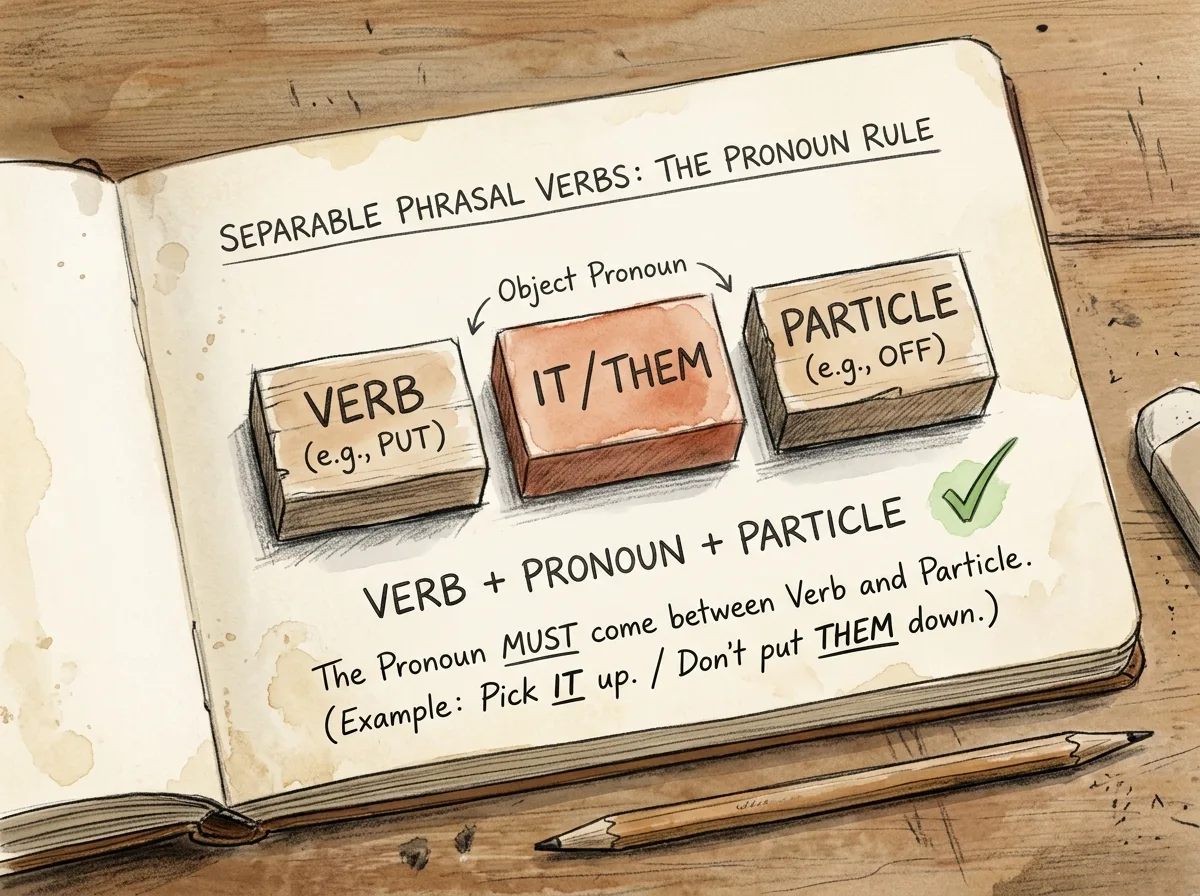
Description
На странице блокнота нарисованы три деревянных кубика в ряд: VERB (например, put), красный кубик IT/THEM посередине и PARTICLE (например, off). Под ними формула «VERB + PRONOUN + PARTICLE» с зелёной галочкой и пример: Pick it up. / Don't put them down. Местоимение у разделяемого глагола зажато между глаголом и частицей.
One nuance: when the noun object is long, the particle is usually kept next to the verb.
- ✅ She turned down the offer that the company had made her in April.
- 🔸 She turned the offer that the company had made her in April down. — grammatical, but nobody says it that way.
Type 3: never split
- ✅ Who looks after the children? ❌ Who looks the children after?
- ✅ I got over the flu. ❌ I got the flu over.
- ✅ She takes after her mother. ❌ She takes her mother after.
Note: get over sth (to recover) is inseparable, while the related get sth over with (to get an unpleasant task over and done with) puts the object in the middle: Let's get the exam over with. A different item — a different rule.
Type 4: all three words go together
- ✅ I can't put up with my neighbours. ❌ I can't put up my neighbours with.
- ✅ We came up with a plan. ❌ We came a plan up with.
- ✅ He got away with it. ❌ He got it away with.
A three-part verb is followed by a noun or an -ing form, but not an infinitive. To here is a preposition, not the infinitive particle:
- ✅ I look forward to hearing from you. ❌ I look forward to hear from you.
- ✅ She owned up to breaking the window. ❌ She owned up to break the window.
1.3 How to tell a verb's type
The type cannot be deduced. It can only be noticed. Two habits make this cheap:
- When you meet a new phrasal verb, immediately try a pronoun in your head. Call off the wedding → call it off → separable. Look after the baby → look after her → inseparable.
- Write the item down together with the object slot:
put sth off,look after sb,put up with sb/sth. The slot is part of the word.
Abbreviations used throughout the course:
| Abbreviation | Meaning |
|---|---|
| sb | somebody |
| sth | something |
| sw | somewhere |
1.4 The particle is not noise
The particle is often thought of as a meaningless add-on. It is not. Each particle has a small set of recurring meanings, and if you know them, you can guess.
| Particle | Recurring meanings | Examples |
|---|---|---|
| up | completion, increase, upward movement, creation | eat up, speed up, stand up, make up |
| down | decrease, writing down, downward movement, defeat | cut down, write down, sit down, put down |
| out | exit, running out, distribution, discovery | walk out, run out, hand out, find out |
| in | entry, handing in, joining in | come in, hand in, join in |
| on | continuation, contact, switching on | carry on, put on, switch on |
| off | separation, departure, cancellation | cut off, set off, call off |
| over | crossing, repetition, handing over, inspection | go over, do over, hand over, look over |
| through | from beginning to end, overcoming, connection | read through, get through, put sb through |
Units 11–17 cover these meanings systematically. For now, just remember: the particle does real work.
1.5 Register: when not to use them
That phrasal verbs are always colloquial is a myth. Compare:
| Phrasal verb | Register | Latinate equivalent |
|---|---|---|
| point out | neutral — appropriate in an academic text | indicate |
| carry out | neutral — the standard in academic style | conduct, perform |
| find out | neutral to colloquial | discover, ascertain |
| put up with | colloquial | tolerate |
| do sb in | slang | kill, exhaust |
| do sb out of sth | slang | defraud |
A reliable heuristic: if a phrasal verb has a one-word Latinate synonym that you would put in a report (tolerate, postpone, investigate), the phrasal verb is the colloquial member of the pair. If there is no such synonym (point out, carry out, set up), the verb is neutral.
1.6 Listening: why phrasal verbs vanish in speech
In natural speech the particle is reduced and runs together with the surrounding words, so you may not catch a verb you know:
- pick it up → /pɪkɪˈdʌp/
- give it up → /gɪvɪˈdʌp/
- put it off → /pʊdɪˈdɒf/
The stressed syllable is the particle. Train yourself to catch the stressed up / out / off / on and reconstruct the verb backwards from it.
1.7 What gets in the way for Russian speakers
Russian builds the same meanings with prefixes. Hence three habits:
- reaching for a single Latinate verb where English prefers a phrasal one: I will postpone the meeting where a colleague would say I'll put the meeting off;
- calquing the particle from one's own prefix — put on the light instead of turn on the light, make out a plan instead of draw up a plan;
- avoiding phrasal verbs in speech altogether, which makes it sound stiff and bookish.
None of this is a grammatical error. These are errors of naturalness, and they are cured by listening and by deliberate substitution exercises.
1.8 Self-check
- □ I can name the four structural types and give an example of each.
- □ I place the pronoun correctly with a separable verb.
- □ I remember that three-part verbs are not split and take -ing, not an infinitive.
- □ I can name at least four meanings each of up and out.
- □ I can explain why put up with is a poor choice for an official report.