English Phrasal Verbs (Extended)
An extended course of English phrasal verbs for B2–C1. The first half is built around the most frequent base verbs (do, make, get, take, give, come, put, run, set, keep, go, turn, bring, see, play, draw, call, hold, lay, bear, let, work, be), the second around particles (up, down, in, out, on, off, over, through, around/about, with, for, to, of, back, away, at, by, into, after, against, together, as). Separate units cover the syntax of phrasal verbs, the language of movement and road vocabulary, and antonym and synonym clusters. The course insists that a particle carries a stable meaning of its own: once you grasp the logic of up/down/out/off, you start inferring what unfamiliar combinations mean instead of memorising them as a list. The syllabus (scope and order of topics) follows Dave Nicholls, «Visual Phrasal Verbs» (2019); all explanations, examples and exercises were written anew for this course.
Explanations are in your language: your assistant gives them.
- Teaches: English
- Material: Russian
- Exam: English — taken on the site, not translated
How it works
Your assistant takes the course material from our server and leads the lesson in your language.
Your assistant explains in your language, but examples, samples and the names of what is being explained stay as the course has them: translating them would lose the subject.
The exam is taken on the site, without an assistant, in the language being taught. Exam questions are not translated: this is decided for every course.
Path through the course
· 18 unitsthe order is free · the steps below are the order the author suggests, not a conditionView: map · steps
Stage 1
~3 h
Stage 2
~45.5 h
by the author’s design, after “How Phrasal Verbs Work: Syntax, Separability, Register”
2
~2.5 h
3
~3 h
4
~3.5 h
5
~3.5 h
6
~3 h
7
~3 h
8
~3 h
9
~3 h
10
Movement, Falling and the Road
~2.5 h
11
The Particle UP and the Particle DOWN
~2.5 h
12
The Particle IN and the Particle OUT
~2.5 h
13
The Particle ON and the Particle OFF
~2.5 h
14
OVER, THROUGH and AROUND / ABOUT
~2.5 h
15
~3 h
16
~3 h
17
AFTER, AGAINST, TOGETHER and AS
~2.5 h
Stage 3
~3 h
18 · by the author’s design, after 12 of these: “How Phrasal Verbs Work: Syntax, Separability, Register”, “DO and MAKE”, “GET: The Most Productive Verb”, “TAKE, GIVE and PUT”, “COME, GO and RUN”, “SET, KEEP and HOLD”, “TURN, BRING and DRAW”, “SEE, PLAY, CALL and WORK”, “LAY, BEAR, LET and BE”, “Movement, Falling and the Road”, “The Particle UP and the Particle DOWN”, “The Particle IN and the Particle OUT”, “The Particle ON and the Particle OFF”, “OVER, THROUGH and AROUND / ABOUT”, “WITH, FOR, TO and OF”, “BACK, AWAY, AT, BY and INTO”, “AFTER, AGAINST, TOGETHER and AS”
Antonyms, Synonyms and Clusters: Consolidation
~3 h
Exam
closed · enrol on the course
final · in the browser, without the assistant
Exam
The path in words
- Stage 1 · How Phrasal Verbs Work: Syntax, Separability, Register — ~3 h
- Stage 2 · DO and MAKE — by the author’s design, after “How Phrasal Verbs Work: Syntax, Separability, Register”; ~2.5 h
- Stage 2 · GET: The Most Productive Verb — by the author’s design, after “How Phrasal Verbs Work: Syntax, Separability, Register”; ~3 h
- Stage 2 · TAKE, GIVE and PUT — by the author’s design, after “How Phrasal Verbs Work: Syntax, Separability, Register”; ~3.5 h
- Stage 2 · COME, GO and RUN — by the author’s design, after “How Phrasal Verbs Work: Syntax, Separability, Register”; ~3.5 h
- Stage 2 · SET, KEEP and HOLD — by the author’s design, after “How Phrasal Verbs Work: Syntax, Separability, Register”; ~3 h
- Stage 2 · TURN, BRING and DRAW — by the author’s design, after “How Phrasal Verbs Work: Syntax, Separability, Register”; ~3 h
- Stage 2 · SEE, PLAY, CALL and WORK — by the author’s design, after “How Phrasal Verbs Work: Syntax, Separability, Register”; ~3 h
- Stage 2 · LAY, BEAR, LET and BE — by the author’s design, after “How Phrasal Verbs Work: Syntax, Separability, Register”; ~3 h
- Stage 2 · Movement, Falling and the Road — by the author’s design, after “How Phrasal Verbs Work: Syntax, Separability, Register”; ~2.5 h
- Stage 2 · The Particle UP and the Particle DOWN — by the author’s design, after “How Phrasal Verbs Work: Syntax, Separability, Register”; ~2.5 h
- Stage 2 · The Particle IN and the Particle OUT — by the author’s design, after “How Phrasal Verbs Work: Syntax, Separability, Register”; ~2.5 h
- Stage 2 · The Particle ON and the Particle OFF — by the author’s design, after “How Phrasal Verbs Work: Syntax, Separability, Register”; ~2.5 h
- Stage 2 · OVER, THROUGH and AROUND / ABOUT — by the author’s design, after “How Phrasal Verbs Work: Syntax, Separability, Register”; ~2.5 h
- Stage 2 · WITH, FOR, TO and OF — by the author’s design, after “How Phrasal Verbs Work: Syntax, Separability, Register”; ~3 h
- Stage 2 · BACK, AWAY, AT, BY and INTO — by the author’s design, after “How Phrasal Verbs Work: Syntax, Separability, Register”; ~3 h
- Stage 2 · AFTER, AGAINST, TOGETHER and AS — by the author’s design, after “How Phrasal Verbs Work: Syntax, Separability, Register”; ~2.5 h
- Stage 3 · Antonyms, Synonyms and Clusters: Consolidation — by the author’s design, after 12 of these: “How Phrasal Verbs Work: Syntax, Separability, Register”, “DO and MAKE”, “GET: The Most Productive Verb”, “TAKE, GIVE and PUT”, “COME, GO and RUN”, “SET, KEEP and HOLD”, “TURN, BRING and DRAW”, “SEE, PLAY, CALL and WORK”, “LAY, BEAR, LET and BE”, “Movement, Falling and the Road”, “The Particle UP and the Particle DOWN”, “The Particle IN and the Particle OUT”, “The Particle ON and the Particle OFF”, “OVER, THROUGH and AROUND / ABOUT”, “WITH, FOR, TO and OF”, “BACK, AWAY, AT, BY and INTO”, “AFTER, AGAINST, TOGETHER and AS”; ~3 h
Programme · 18 units
| 1 | How Phrasal Verbs Work: Syntax, Separability, Register Distinguish a phrasal verb from a verb with an ordinary preposition | ~3 h |
| 2 | DO and MAKE Use the main meanings of do up, do over, do in, do without, do away with, do sb down, do sb out of | ~2.5 h |
| 3 | GET: The Most Productive Verb Use get across, get at, get away (with), get back (at / to), get into, get on with, get over, get through, get round to, get down to, get out of | ~3 h |
| 4 | TAKE, GIVE and PUT Use take after, take in, take on, take off, take over, take up, take back, take to | ~3.5 h |
| 5 | COME, GO and RUN Use come across, come up with, come up against, come round, come off, come out, come down to | ~3.5 h |
| 6 | SET, KEEP and HOLD Use set off, set out, set up, set about, set aside, set back, set in | ~3 h |
| 7 | TURN, BRING and DRAW Use turn up, turn down, turn into, turn out, turn over, turn against, turn to | ~3 h |
| 8 | SEE, PLAY, CALL and WORK Use see about, see off, see through, see to, see out | ~3 h |
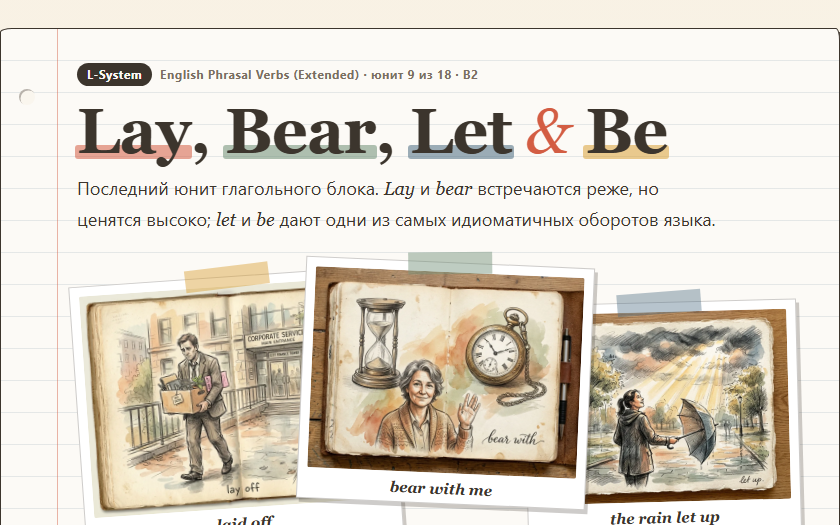
| 9 | LAY, BEAR, LET and BE Use lay off, lay out, lay down, lay into | ~3 h |
| 10 | Movement, Falling and the Road Describe falls, bending, postures and approaching with the right particle | ~2.5 h |
| 11 | The Particle UP and the Particle DOWN Explain the five basic meanings of UP: upward, completion, increase, approach, creation | ~2.5 h |
| 12 | The Particle IN and the Particle OUT Explain the basic meanings of IN: inward, handing in, joining in, giving in | ~2.5 h |
| 13 | The Particle ON and the Particle OFF Explain the basic meanings of ON: contact, continuation, switching on, support and target | ~2.5 h |
| 14 | OVER, THROUGH and AROUND / ABOUT Explain the basic meanings of OVER: on top, again, handing over, looking over, beyond measure | ~2.5 h |
| 15 | WITH, FOR, TO and OF Use put up with, go along with, come up with, do away with, get away with, bear with | ~3 h |
| 16 | BACK, AWAY, AT, BY and INTO Use the basic meanings of BACK (return, striking back, holding back) and AWAY (leaving, disappearing, long sustained activity) | ~3 h |
| 17 | AFTER, AGAINST, TOGETHER and AS Use take after, look after, run after, name after, be after, ask after | ~2.5 h |
| 18 | Antonyms, Synonyms and Clusters: Consolidation Find antonyms for phrasal verbs across the whole course | ~3 h |