
Hello, neighbour: meeting the neighbour · to be (am / is / are), pronouns, my / your / his / her
Level: A1. Grammar: the verb to be in affirmative sentences (am / is / are), personal pronouns, my / your / his / her / our / their. Situation: meet your neighbour, introduce your family, spell your name letter by letter, address a person correctly. This is the first unit of the course. It relies only on what you already know: a few English words and the wish to start speaking.
1. The situation
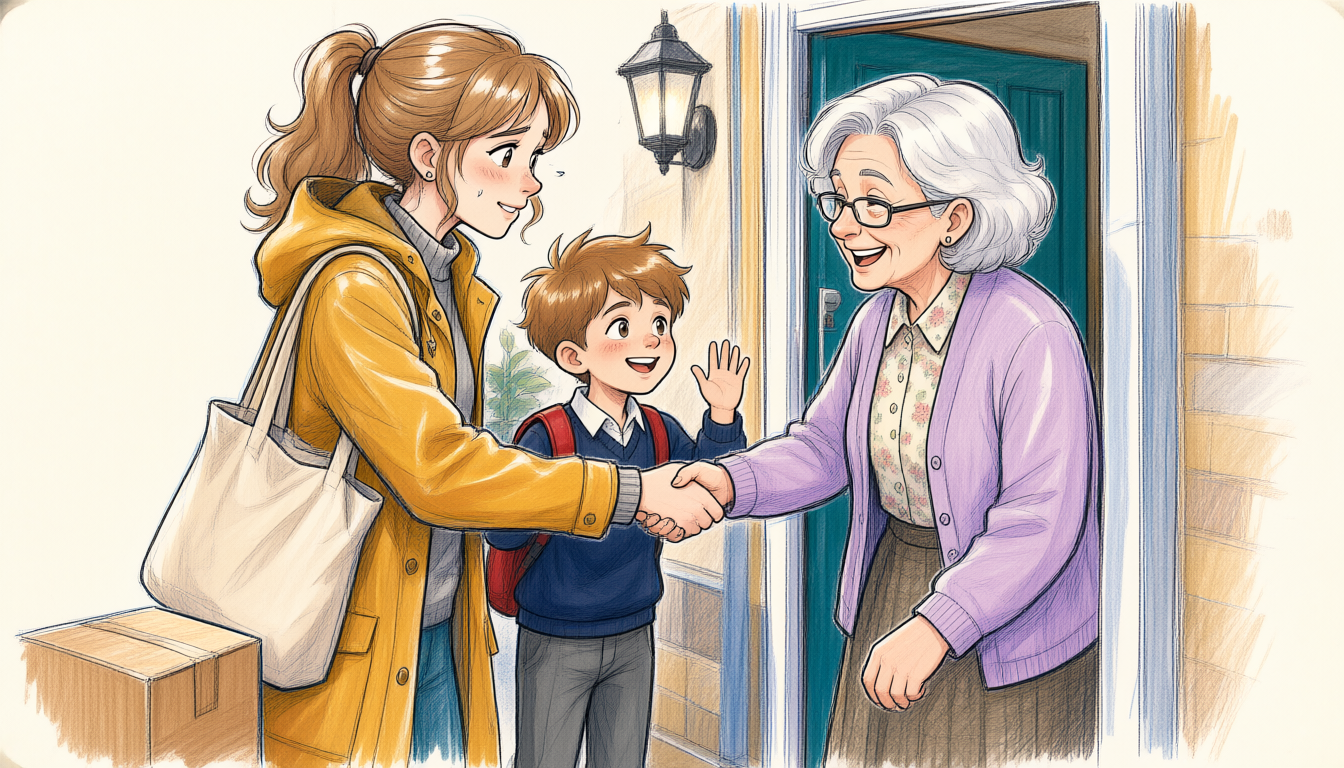
Marina and her family have just moved into a new flat — Flat 4, 27 Mill Lane, in the small English town of Ashbury. It is Saturday morning. Marina and nine-year-old Max are carrying in boxes. The door opposite opens, and an elderly woman in a lilac cardigan and round glasses steps out onto the landing. She smiles: Hello there! I'm Margaret Wood. I'm in Flat 5, just opposite.
Marina wants to answer: "Hello, I'm Marina, your new neighbour. This is my son." In Russian such phrases have no verb: «я — Марина», «это — мой сын». But in English you cannot do without the verb: I'm Marina. This is my son. This little verb — to be — is the main topic of the unit.
Then Margaret asks for her surname and asks her to spell it letter by letter. Marina knows the letters from school, but H, R and Z sound quite different in English from what she is used to.
Description
Цветной скетч карандашами и маркерами, персонажи в аниме-манере. Лестничная площадка многоквартирного дома, крупным планом у открытой двери. Слева стоит Марина — женщина под сорок, светло-русые волосы в хвосте, горчично-жёлтый дождевик поверх серого свитера, джинсы, холщовая сумка на плече. У её ног картонная коробка. Она протягивает руку для рукопожатия и улыбается немного смущённо. Рядом с ней девятилетний Макс в тёмно-синем школьном джемпере, серых брюках и с красным рюкзаком, он машет рукой. Справа, в дверном проёме, стоит Margaret — пожилая женщина с белыми кудрявыми волосами, в круглых очках и сиреневом кардигане. Она тепло улыбается и пожимает Марине руку. На полу коврик у двери, на стене светильник, сбоку дверной косяк. Идея: первое знакомство — короткие фразы с глаголом to be, и к ним можно подготовиться заранее.
2. How people address each other in Britain
These are not official rules but habits that will help you avoid awkward situations.
- Mr, Mrs, Ms, Miss go only before the surname: Mrs Wood, Mr Hughes. The combination "title + first name" (Mrs Margaret) sounds odd — only children at nursery talk like that.
- Mr [МИстэ] — a man. Mrs [МИсиз] — a married woman. Miss [мис] — an unmarried woman, more often about young women. Ms [мэз] — a neutral title for any woman, if you don't know or don't want to state her marital status. On forms you will also see Mx [микс] — a neutral title that does not indicate gender.
- Neighbours and colleagues quickly move on to first names. The signal is the phrase Please call me Margaret or Call me Margaret. After it, Mrs Wood already sounds a little cold.
- There is no separate polite «Вы» in English: you is both «ты» and «вы». Politeness comes from other things: please, thank you, sorry, Could you…?, a smile, and using the surname until you are asked otherwise.
- The teachers at Max's school are also Mr / Mrs / Ms + surname: Ms Clarke. Children always say it this way.
3. Phrases: take them with you
Meeting someone
- Hello, I'm Marina. I'm your new neighbour. — Hello, I'm Marina, your new neighbour.
- I'm in Flat 4. — I live in flat 4 (literally "I'm in flat 4").
- Nice to meet you. — Pleased to meet you.
- Nice to meet you too. — Pleased to meet you too (the reply).
- This is my son, Max. — This is my son Max.
- My husband is at work. — My husband is at work.
- Please call me Margaret. — Call me Margaret.
Name and letters
- Sorry, what's your name again? — Sorry, what's your name? (if you have forgotten)
- Could you spell that, please? — Spell it letter by letter, please.
- It's P-E-T-R-O-V-A. — Letter by letter: П-Е-Т-Р-О-В-А.
- Double S. / Double O. — Two S's in a row, two O's in a row.
- Is that with a W? — Is that with a W?
Saying goodbye
- See you later. / See you soon. — See you.
- Welcome to Mill Lane! — Welcome to Mill Lane! (this is what people will say to you)
Words
| English | Meaning | Note |
|---|---|---|
| neighbour | neighbour (man or woman) | British spelling with -our; pronounced [НЕЙбэ] |
| flat | flat | Americans say apartment — you will hear that too |
| opposite | opposite | I'm in Flat 5, just opposite. |
| next door | next door, on the other side of the wall | Our neighbours next door are very nice. |
| first name / surname | first name / surname | in detail — in u02 |
| husband / wife | husband / wife | |
| son / daughter | son / daughter | son is pronounced like sun [сан] |
| Mrs / Ms | titles for a woman | only with the surname: Mrs Wood |
4. The alphabet: the letters people stumble on
In English, letters are named differently from the school "German" way of reading. It is convenient to learn them in groups: each group has the same vowel sound.
Description
Слева блок с надписью «английский алфавит: 7 групп по звуку», от него стрелки к семи блокам. Первая группа A, H, J, K — звук как в слове day. Вторая группа B, C, D, E, G, P, T, V — звук как в слове see. Третья группа F, L, M, N, S, X, Z — звук как в слове pen, с пометкой, что Z в Британии называют zed. Четвёртая группа I и Y — звук как в слове my. Пятая — одна буква O, как в слове no. Шестая — Q, U, W, как в слове you. Седьмая — одна буква R, как в слове car. Блоки окрашены попеременно в розовый и мятный цвет.
Traps for Russian speakers:
- H — [эйч], not [хэ] and not [аш].
- R — [а:], as in car; the British do not pronounce the r sound at the end.
- Z — [зед]. You will also hear the American [зи:].
- E — [и:], and I — [ай]. These are the ones confused most often: Petrova is spelled P-E-T…, not P-I-T….
- G — [джи:], J — [джей]. So as not to mix them up: G is in the group with see, J — with day.
- W — [ДАбл ю], that is, "double U".
- Two identical letters in a row — double: Wood — W, double O, D.
5. Grammar: to be — am, is, are
The pain
In Russian we say «Я Марина», «Она соседка», «Макс в школе» — the verb «быть» has disappeared in the present tense. An English sentence without a verb falls apart. A Brit will understand I Marina or She my neighbour, but will hear "me no understand" broken speech. The verb to be means "is / is (something) / is located", and in the present tense it has three forms.
Form
| Pronoun | Full form | Short form (in speech) | Example |
|---|---|---|---|
| I | I am | I'm | I'm Marina. |
| you | you are | you're | You're very kind. |
| he | he is | he's | He's my son. |
| she | she is | she's | She's my neighbour. |
| it | it is | it's | It's a nice flat. |
| we | we are | we're | We're in Flat 4. |
| they | they are | they're | They're at school. |
With a name — the same as with he / she / it: Max is nine. Oleg is at work. Margaret is very kind.
Whose is it: my, your, his, her
| Who | Whose | Example |
|---|---|---|
| I | my | This is my son. |
| you | your | Is this your bag? |
| he | his | Max is nine. His school is near here. |
| she | her | Margaret is my neighbour. Her flat is opposite. |
| it | its | The flat is small, but its kitchen is nice. |
| we | our | Our flat is on the first floor. |
| they | their | Their names are Max and Oleg. |
Where it breaks (the cost)
- Leaving out the verb. I Marina. She my neighbour. He at work. The most common mistake Russian speakers make at the start. Correct: I'm Marina. She's my neighbour. He's at work.
- His or her — by the owner, not by the thing. «Её сын» — her son (the owner is a woman). «Его мама» — his mum (the owner is a boy). In Russian speakers' speech he and she are often mixed up automatically; Margaret will understand but will ask again.
- There is no «свой» in English. «Марина со своим сыном» — Marina is with her son, «я со своим мужем» — I'm with my husband. Choose the pronoun by whose it is.
- Mrs + first name. Mrs Margaret — wrong. Only Mrs Wood or Margaret.
- A job without a. She's teacher — wrong, you need She's a teacher. We will look at why in u03; for now just remember: before a job in the singular there is a.
- I am or I'm? Both forms are correct. In conversation I'm is normal; the full I am sounds emphatic: I am Marina! — "yes, I am Marina".
6. Dialogue: on the landing
Margaret: Hello there! I'm Margaret Wood. I'm in Flat 5, just opposite. Marina: Hello! I'm Marina. I'm your new neighbour. Nice to meet you. Margaret: Nice to meet you too, Marina. Sorry, what's your surname? Marina: It's Petrova. Margaret: Could you spell that, please? Marina: Yes, of course. P-E-T-R-O-V-A. Margaret: Lovely. And who's this young man? Marina: This is my son, Max. He's nine. Max: Hello, Mrs Wood. Margaret: Hello, Max. Oh, please call me Margaret. Marina: My husband is Oleg. He's at work today. Margaret: Well, welcome to Mill Lane. My door is always open. Marina: Thank you, Margaret. You're very kind. Margaret: Not at all. See you soon!
In the evening Marina talks about her neighbour:
Marina: Margaret is very nice. She's teacher. Max: Mum, she's a teacher. Well, she's a retired teacher. (retired — on a pension) Marina: OK, OK. She's a retired teacher. And her flat is opposite.
Politeness. Compare how this sounds to a Brit:
| Abrupt (don't do this) | Normal |
|---|---|
| Who are you? | Hello, I'm Marina, your new neighbour. |
| What is your name? — straight away, without your own name | Hi, I'm Marina. Sorry, what's your name? |
| Spell! / Again! | Could you spell that, please? |
| Yes. — in reply to Nice to meet you | Nice to meet you too. |
| Hello, Mrs Margaret. | Hello, Mrs Wood. or Hello, Margaret. |
In English, Who are you? sounds almost like "and who might you be?" — that is how you question a stranger who is doing something at your door. Start with yourself: say your name, and the other person will say theirs.
7. Sound
- Short forms merge with the pronoun: I'm [айм], you're [йо:], he's [хиз], she's [шиз], we're [уиэ], they're — sounds like there. Don't split them: not [ай эм], but [айм].
- H — a light breath out, as onto a misted window: he, hello, husband. Not the Russian [х] with a rasp.
- th in this, the, they, their — the tip of the tongue between the teeth. Not [зис] and not [дис].
- Nice to meet you — [найс тэ МИИТ ю]: meet has the long sound [и:], to is almost swallowed.
- Neighbour [НЕЙбэ], opposite [Опэзит] — stress on the first syllable.
8. Summary
- To be in the present: I'm, you're, he's, she's, it's, we're, they're. Without it an English sentence does not work: I'm Marina, not I Marina.
- Whose: my, your, his, her, its, our, their. His or her — by the owner.
- Mrs / Mr / Ms — only with the surname. The signal to move on to first names — Call me Margaret.
- Three phrases to take with you: Hello, I'm Marina. I'm your new neighbour. — Nice to meet you too. — Could you spell that, please?